What we teach
The doctrine first, then the practices, the ones you live and the ones you sit down for, then the ground under all of it.
Spiritism: the Kardec foundation
The spine of everything else on this site.
Spiritism is not a religion you join; it is a body of knowledge, codified by Allan Kardec in the mid-nineteenth century from a systematic and repeated investigation of spirit communication. It answers, in order, the questions every other tradition either skips or answers with poetry: what is a spirit, what is the perispirit, why do we incarnate, what happens at death, why does one person suffer and another not, and what is the moral law actually made of.
The Spirits' Book
1,019 questions put to spirits and answered across multiple independent mediums. The foundation text, and still the most systematic spiritual document ever assembled.
The perispirit
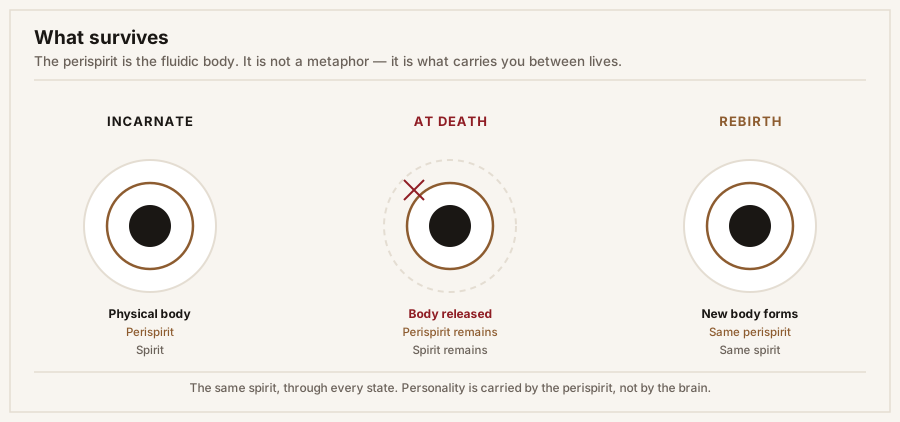
The fluidic body that survives death and re-forms at rebirth. Not a metaphor, but the mechanism that explains projection, mediumship and memory beyond the brain.
Reincarnation
Necessary for progress, and the only account of inequality that doesn't require either a cruel God or an indifferent one. You are not being punished; you are being taught.
The moral laws
Kardec's Part Three applied to real life: labor, society, equality, freedom, justice, charity and love. Practical ethics with no loopholes and no exemptions.
The always-on practices
No session. Nothing to schedule. These are the water you swim in.
These cannot be timetabled, because there is no session to put in the calendar. They are not things you do for forty minutes and then stop. They are the conditions everything else happens inside. Which means you are either practising them at this moment or you are not practising them at all.
This is where most people quietly fail, and the failure is not dramatic. Nobody abandons presence; they simply promise to start it tomorrow morning, and tomorrow morning never has a slot. There is no slot. There is only now.
Presence
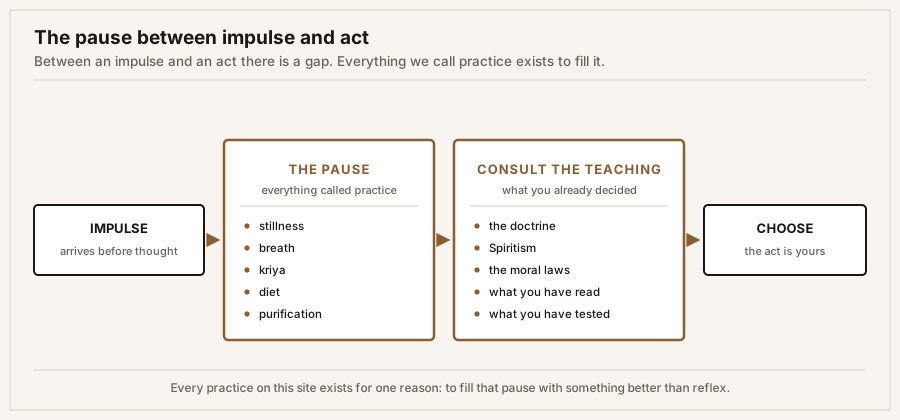
The gap between an impulse and an act. Impulses arrive before thought does. That is the whole problem, and it is also the whole opportunity, because a gap you can stand in is a gap you can decide from. Every sitting practice exists to widen it.
Responsibility
The root. Nothing here will work on you until you accept that the state of your life is yours to work on. Impulses arriving before thought is not your fault. What you do with the gap afterwards is entirely yours. Not guilt, which is only ever about the past and changes nothing: responsibility, which is about what happens next.
Diet and rhythm: Ayurveda
Your constitution, the food and daily rhythm that suit it, and the discipline of a clean vessel. One of us eats one meal a day and has never found a practice that works better on a full stomach and a poisoned system. You don't need to adopt a whole lifestyle. You need to know which machine you are running and stop putting the wrong fuel in it.
The stillness practices
You sit down for these. A time, a seat, a duration. They are the purification.
Unlike the practices above, these are done rather than lived. There is no way to be practising them casually. You either sat today or you didn't. All four work on the same instrument from four directions, and they are listed here in the order they tend to be learned: the body first, then the breath, then the mind, then the address.
Yoga: the body
Posture as preparation, not performance. Not a fitness class and not a stretching routine, but a technology of consciousness, and the umbrella the other body practices hang from. You are getting the instrument into a condition where stillness is possible rather than a fight. A tense body will not hold a quiet mind no matter how sincere the intention.
Pranayama: the breath
The direct lever. Breath is the one part of the nervous system you can reach with your own hands, and changing its rhythm changes your state faster than anything else on this page. Slow it and the body follows. This is why breath work sits underneath meditation rather than beside it. You are not relaxing; you are setting a rate the mind then has to match.
Meditation: the stillness
Fifteen to sixty minutes daily, same time and same seat. That repetition is doing more work than the technique is. Nothing mystical is required at the start: you are training a body to be still long enough that the mind stops negotiating. The most boring instruction in spirituality and the only one that reliably works.
Prayer: the address
Not a request list. Prayer is the practice of turning toward something that is not yourself, which is exactly why it belongs to the stillness practices: it is the one that will not let the practice become self-improvement. Ours is the charity meditation: eleven minutes, arms raised, the healing energy offered up and distributed by God according to His wisdom rather than our preference. Prayer with the ego removed from the exchange.
Lucid dreaming & astral travel
One training in two levels. Level one is learning to notice. Level two is learning to travel.
These are the same skill at two depths, and they are taught in order for a reason. Lucid dreaming is level one: the dream you know is a dream. Astral travel is level two: consciousness operating with the body's permission withdrawn entirely. Nobody skips level one comfortably, because the recognition you build in a dream is the same recognition you need mid-crossing — and the thing that decays fastest in both is not the experience but the memory of it, which starts going the moment you surface.
Level 1: Lucid dreaming
The gentlest door into the wider world, and for many people the first honest experience of consciousness operating without a body's permission. We teach recognition, stabilisation, and the transition from a lucid dream toward a conscious crossing. It is also, frankly, the most immediately rewarding thing on this list. Start here. Get good at noticing.
Level 2: Astral travel
Projection is trainable, and it is testable. We teach it the way an engineer would: pre-decision before sleep so that in a state where there is no time to think, the response is already chosen; a physical position that supports entry without inviting sleep; and, above all, a reporting discipline so that what you bring back can be examined. Theory is cheap. This is the discipline that separates us from every other teacher you'll meet.
The anchor word
One word, chosen in advance, that returns you to yourself in a state where thinking has stopped being available. It is a projection technique, not a meditation. It is only ever needed mid-crossing, when there is no time to compose a sentence. Pre-decision is the whole technique, and it is the same muscle as the pause in the always-on practices, trained for a place where the pause is too short to think in.
Reporting discipline
Say what happened within the first seconds of waking, before the memory edits itself. Everything else on this page is preparation; this is the only part that produces data. A crossing you cannot describe is a crossing you cannot test, and a test you cannot run is not evidence.
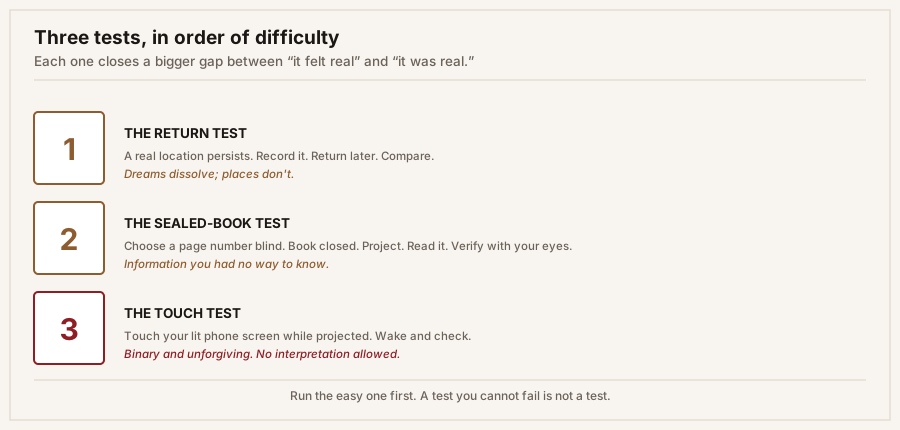
Grade yourself on these, in order of difficulty. Run the easiest one first. A test you cannot fail is not a test.
- The Return TestA real location persists. Record it, return, compare. Dreams drift; places don't.
- The Sealed-Book TestChoose a page number blind, leave the book closed, project, read it, verify with your eyes.
- The Touch TestTouch your lit phone screen while projected. Wake and check. Binary and unforgiving.
We hold ourselves to a testable standard, and we will tell you honestly when a result is inconclusive rather than dress it up as a success. You are welcome to hold us to that.
Consciousness & the CTMU
The ground under the doctrine.
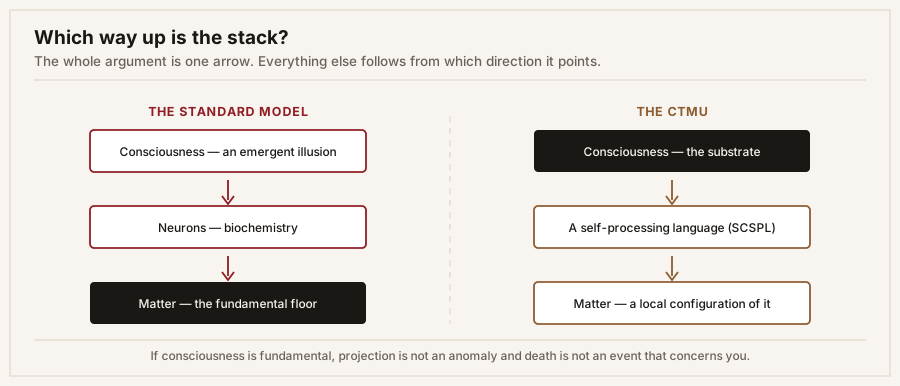
Kardec's "vital principle" and Christopher Langan's Cognitive-Theoretic Model of the Universe are, as far as we can tell, describing the same room from two different doors. Both hold that consciousness is not produced by matter. Matter is a local expression of consciousness, and the universe is closer to a self-describing language than to a machine.
This matters practically. If consciousness is fundamental, projection is not an anomaly to be explained away, mediumship is not wishful thinking, and death is not an event that concerns you. The doctrine stops being a comforting belief and becomes a description of the structure you're already living inside.